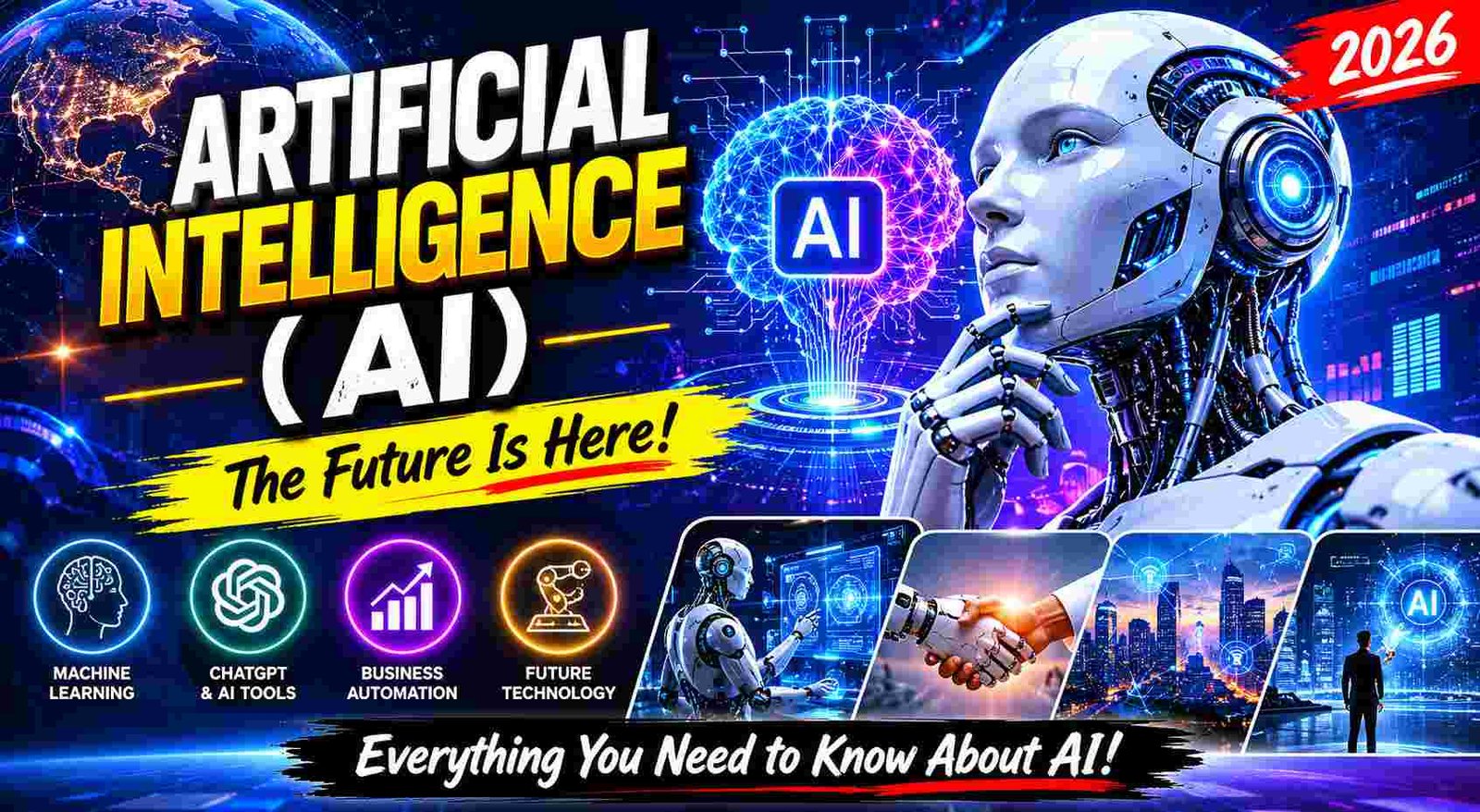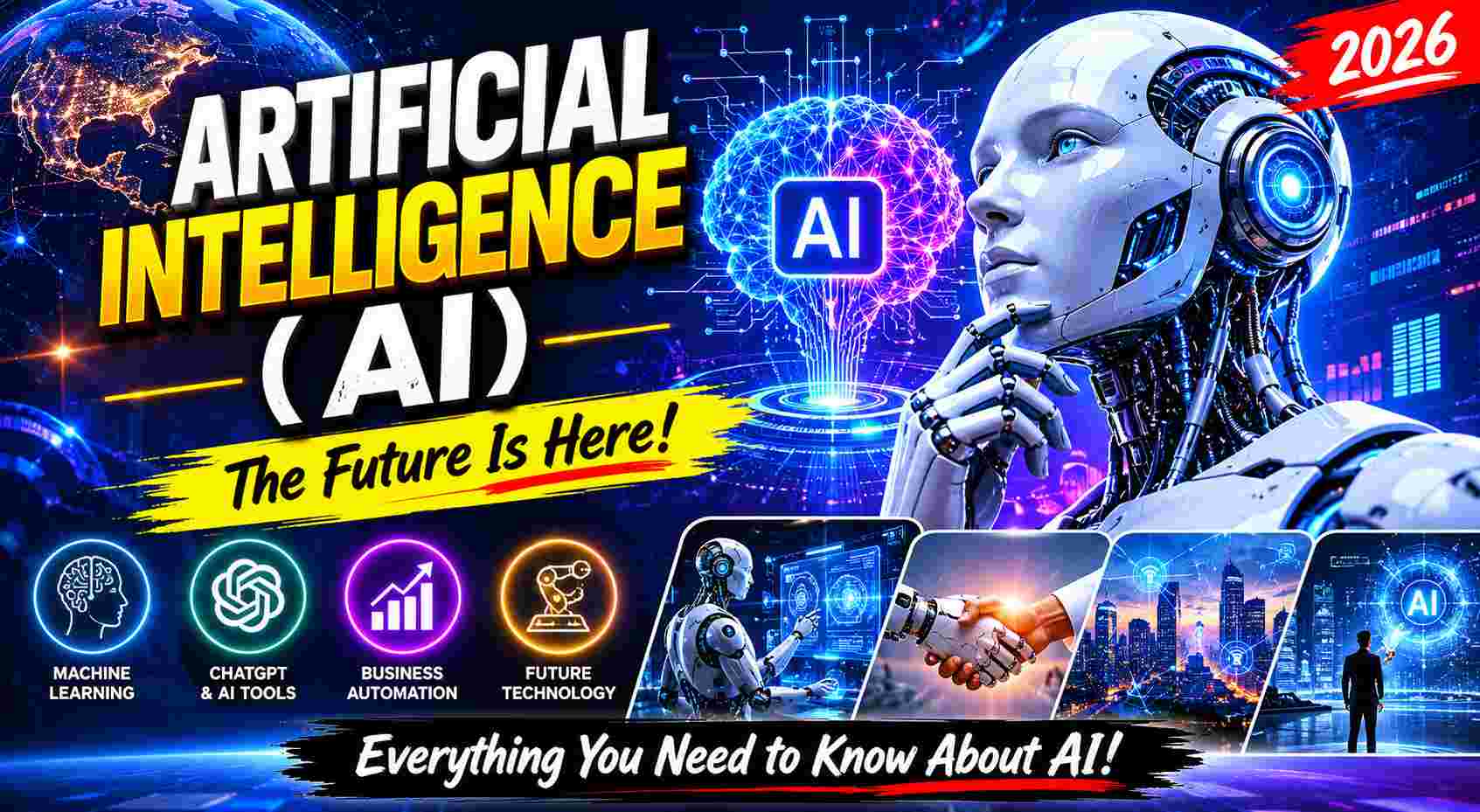
Artificial Intelligence (AI): The Complete Guide to How AI Is Transforming Our World in 2026
Introduction
Artificial Intelligence (AI) has rapidly evolved from a futuristic concept into one of the most powerful technologies shaping the modern world. Whether you realize it or not, AI is already influencing your daily life. From the recommendations you receive on Netflix and Amazon to the navigation routes suggested by Google Maps, AI is working behind the scenes to make decisions, analyze data, and improve user experiences.
In recent years, the rise of advanced AI systems such as ChatGPT, AI-powered search engines, autonomous vehicles, and intelligent business tools has accelerated the adoption of artificial intelligence across industries. Businesses are investing billions of dollars in AI technologies to improve efficiency, reduce costs, enhance customer experiences, and gain a competitive advantage.
As we move deeper into the digital age, understanding AI is no longer optional. Whether you are a student, entrepreneur, professional, or technology enthusiast, learning about artificial intelligence can help you stay ahead in a rapidly changing world.
This comprehensive guide explores what AI is, how it works, its benefits, challenges, applications, and what the future holds for this revolutionary technology.
What Is Artificial Intelligence?
Artificial Intelligence refers to the simulation of human intelligence by machines and computer systems. AI enables machines to perform tasks that traditionally require human thinking, such as learning, reasoning, problem-solving, understanding language, recognizing images, and making decisions.
Unlike traditional software that follows fixed rules, AI systems can analyze data, identify patterns, and improve their performance over time. This ability to learn from experience makes AI incredibly powerful.
The ultimate goal of AI is to create systems that can think, learn, and adapt in ways similar to humans.
Today, AI powers countless applications, including:
-
Virtual assistants
-
Recommendation systems
-
Language translation tools
-
Medical diagnosis systems
-
Autonomous vehicles
-
Fraud detection software
-
Customer service chatbots
-
Smart home devices
As computing power increases and data becomes more accessible, AI continues to become more capable and sophisticated.
How Does Artificial Intelligence Work?
AI works by combining large amounts of data with advanced algorithms and computing power.
The process generally includes the following steps:
Data Collection
AI systems require massive amounts of data to learn. This data may include text, images, videos, audio recordings, customer behavior, financial transactions, or medical records.
Data Processing
The collected data is cleaned, organized, and prepared for analysis.
Machine Learning
Machine learning is a subset of AI that allows computers to learn from data without explicit programming.
Instead of being told exactly what to do, machine learning models discover patterns and make predictions based on previous examples.
Deep Learning
Deep learning is an advanced form of machine learning that uses artificial neural networks inspired by the human brain.
Deep learning enables AI to perform complex tasks such as:
-
Facial recognition
-
Speech recognition
-
Natural language understanding
-
Image classification
Continuous Improvement
As AI systems receive more data and feedback, they become increasingly accurate and efficient.
This ability to improve over time is one of the reasons AI is transforming industries worldwide.
Types of Artificial Intelligence
Narrow AI
Narrow AI is designed for specific tasks.
Examples include:
-
Siri
-
Alexa
-
Google Assistant
-
ChatGPT
-
Recommendation algorithms
Most AI systems in use today fall under this category.
General AI
General AI refers to machines capable of performing any intellectual task that a human can perform.
Researchers continue working toward this goal, but General AI does not yet exist.
Super AI
Super AI is a theoretical concept where machines surpass human intelligence in every area.
Although frequently discussed in science fiction, Super AI remains a future possibility rather than a current reality.
Key Technologies Behind AI
Machine Learning
Machine learning enables systems to learn from experience and improve automatically.
It is used in:
-
Fraud detection
-
Recommendation systems
-
Predictive analytics
-
Search engines
Natural Language Processing (NLP)
NLP allows computers to understand and generate human language.
Applications include:
-
Chatbots
-
Virtual assistants
-
Language translation
-
AI writing tools
Computer Vision
Computer vision enables machines to interpret visual information.
Examples include:
-
Facial recognition
-
Medical image analysis
-
Self-driving cars
-
Security surveillance
Robotics
AI-powered robots can perform tasks autonomously or with minimal human supervision.
Industries using robotics include:
-
Manufacturing
-
Healthcare
-
Agriculture
-
Logistics
Benefits of Artificial Intelligence
Increased Productivity
AI automates repetitive tasks, allowing employees to focus on strategic and creative work.
Improved Accuracy
Machines can process information with greater consistency and fewer errors than humans.
Better Customer Experiences
AI helps businesses provide personalized recommendations and instant customer support.
Cost Reduction
Automation reduces labor costs and operational expenses.
Faster Decision-Making
AI analyzes large datasets quickly and provides actionable insights.
Innovation and Growth
AI enables organizations to develop new products, services, and business models.
AI in Healthcare
Healthcare is one of the industries benefiting most from AI innovation.
Disease Detection
AI can analyze medical images and identify diseases earlier than traditional methods.
Personalized Medicine
AI helps doctors create customized treatment plans based on patient data.
Drug Discovery
Pharmaceutical companies use AI to accelerate drug research and development.
Virtual Health Assistants
AI-powered assistants help patients schedule appointments and receive medical guidance.
As healthcare data continues to grow, AI will play an increasingly important role in improving patient outcomes.
AI in Business
Businesses worldwide are adopting AI to gain competitive advantages.
Customer Service
AI chatbots provide 24/7 customer support.
Marketing
AI helps companies:
-
Analyze customer behavior
-
Personalize campaigns
-
Improve targeting
-
Predict purchasing trends
Finance
Banks use AI for:
-
Fraud detection
-
Risk assessment
-
Credit scoring
-
Automated trading
Human Resources
AI assists with:
-
Resume screening
-
Candidate matching
-
Workforce analytics
Organizations that successfully implement AI often achieve greater efficiency and profitability.
AI in Education
Education is undergoing significant transformation through AI.
Personalized Learning
AI adapts lessons based on student performance and learning styles.
Automated Grading
Teachers save time through AI-assisted grading systems.
Virtual Tutors
Students receive additional support through AI-powered tutoring platforms.
Learning Analytics
Educational institutions use AI to identify students who may need extra assistance.
These innovations improve learning outcomes and accessibility.
AI in Transportation
The transportation industry is being reshaped by artificial intelligence.
Self-Driving Vehicles
Autonomous vehicles use AI to navigate roads and make driving decisions.
Traffic Management
AI analyzes traffic patterns to reduce congestion.
Route Optimization
Delivery companies use AI to find the fastest and most efficient routes.
Predictive Maintenance
Transportation providers use AI to identify maintenance issues before failures occur.
These advancements improve safety and efficiency.
Generative AI: The New Revolution
One of the most exciting developments in AI is Generative AI.
Generative AI can create:
-
Text
-
Images
-
Videos
-
Music
-
Software code
Popular generative AI applications include:
-
ChatGPT
-
AI image generators
-
AI video tools
-
AI coding assistants
Generative AI is changing content creation, software development, marketing, and entertainment.
Many experts believe Generative AI will become one of the most influential technologies of the decade.
Challenges and Risks of Artificial Intelligence
Despite its advantages, AI presents important challenges.
Job Displacement
Automation may replace certain repetitive jobs.
Workers must develop new skills to remain competitive.
Privacy Concerns
AI systems often rely on large amounts of personal data.
Organizations must protect user information responsibly.
Bias and Fairness
AI can inherit biases present in training data.
Developers must ensure AI systems remain fair and unbiased.
Security Risks
Cybercriminals may use AI to create more sophisticated attacks.
Ethical Issues
Questions surrounding accountability, transparency, and decision-making continue to grow.
Addressing these concerns is critical for responsible AI development.
The Future of Artificial Intelligence
The future of AI looks incredibly promising.
Experts predict AI will continue transforming:
-
Healthcare
-
Education
-
Finance
-
Manufacturing
-
Retail
-
Transportation
-
Entertainment
Future developments may include:
-
More advanced virtual assistants
-
Highly intelligent robots
-
Improved medical diagnostics
-
Smarter cities
-
Enhanced cybersecurity systems
-
Personalized digital experiences
Businesses that embrace AI today are likely to become industry leaders tomorrow.
The global AI market is expected to grow significantly over the next decade, creating new opportunities for innovation, employment, and economic growth.
Conclusion
Artificial Intelligence is no longer a futuristic concept—it is a present-day reality that is reshaping the world around us. From healthcare and education to business and transportation, AI is driving innovation across virtually every industry.
The technology offers remarkable benefits, including increased efficiency, improved decision-making, enhanced customer experiences, and groundbreaking scientific advancements. At the same time, society must address challenges related to privacy, ethics, bias, and workforce transformation.
As AI continues to evolve, individuals and organizations that understand and embrace this technology will be best positioned for success in the digital future. Whether you are a business owner, student, developer, or consumer, artificial intelligence is a trend that cannot be ignored.
The AI revolution has only just begun, and its impact on humanity will likely be felt for generations to come.