
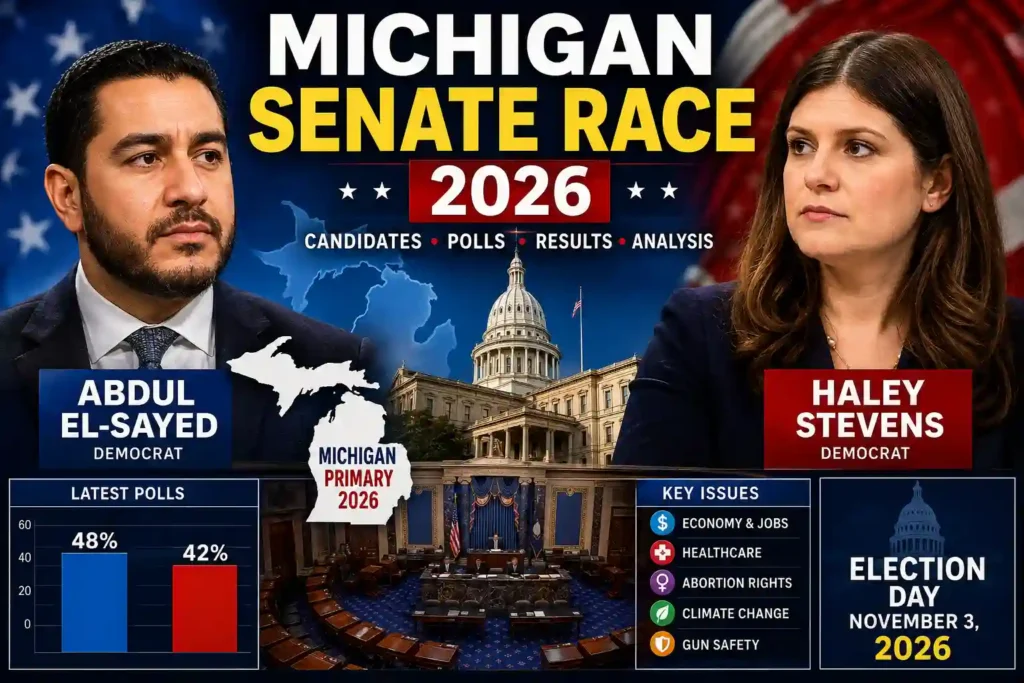
The Michigan Senate race of 2026 is one of the most closely watched elections in the United States because it could influence which party controls the U.S. Senate. The seat became open after Democratic Senator Gary Peters announced that he would not seek re-election, ending more than a decade in the Senate. An open seat in a politically competitive state like Michigan has created a high-profile contest between Democrats and Republicans.
Michigan Senate Race 2026: A High-Stakes Battle That Could Shape the U.S. Senate
The Michigan Senate race in 2026 has emerged as one of the most important elections in the United States. Political analysts, campaign strategists, and voters across the country are closely watching the contest because the outcome could play a significant role in determining which party controls the U.S. Senate. With longtime Democratic Senator Gary Peters choosing not to seek another term, Michigan is holding an open-seat election for the first time in years. Open Senate races are often highly competitive, and this one is no exception.
Michigan has long been considered one of America’s key swing states. In recent elections, the state has alternated between Democratic and Republican victories, making every statewide race unpredictable. Because of this political balance, both major parties are investing millions of dollars in advertising, grassroots organizing, and voter outreach. National political organizations have also made Michigan one of their top priorities for the 2026 election cycle.
On the Democratic side, the race has highlighted different visions for the party’s future. Abdul El-Sayed, a physician and former public health official, has built his campaign around progressive policies. He supports expanding affordable healthcare, lowering prescription drug costs, protecting workers’ rights, and increasing access to education. His campaign has attracted support from several progressive leaders and organizations, particularly among younger voters and urban communities.
His primary opponent, Haley Stevens, represents a more moderate approach. Stevens has emphasized strengthening Michigan’s manufacturing sector, protecting union jobs, supporting small businesses, and expanding investments in advanced technology and clean energy. Her campaign argues that economic growth and bipartisan cooperation are essential for Michigan’s long-term success.
On the Republican side, former Congressman Mike Rogers has positioned himself as the party’s leading candidate. Rogers is focusing on issues such as reducing inflation, strengthening border security, supporting law enforcement, cutting taxes, and increasing American energy production. Republicans believe these issues will resonate with independent voters who remain concerned about the economy and rising living costs.
Several major issues are expected to shape voters’ decisions throughout the campaign. The economy remains the top concern for many Michigan residents, with inflation, housing costs, and job opportunities dominating public discussions. Healthcare is another significant issue, particularly the affordability of insurance and prescription medications. As the home of the U.S. automobile industry, Michigan is also at the center of debates over electric vehicles, manufacturing investment, and the future of union jobs. Candidates continue to present different approaches to balancing economic growth with environmental goals.
Campaign fundraising has already reached impressive levels, with candidates receiving financial support from national organizations, political action committees, and individual donors. Political advertising across television, digital platforms, and social media is expected to intensify as Election Day approaches. Experts predict that the Michigan Senate race will become one of the most expensive Senate contests in the country.
Polls suggest the race is highly competitive, with only a small margin separating the leading candidates. Independent and suburban voters are likely to play a decisive role in determining the winner. High voter turnout, particularly in Detroit, Grand Rapids, Lansing, and surrounding suburban counties, could significantly influence the final result.
In conclusion, the Michigan Senate race of 2026 represents far more than a single state election. It is a contest with national implications that could help determine the balance of power in the U.S. Senate. With strong candidates, closely divided voters, and intense national attention, Michigan is once again proving why it remains one of the most influential battleground states in American politics. As the campaign continues, the race is expected to remain one of the most closely watched political events of the year.
Why This Election Matters
Michigan is considered a battleground (swing) state. In recent presidential elections, the state has been closely divided between Democrats and Republicans. Because of this, both parties view the Michigan Senate race as essential to their national strategy.
The winner will:
- Represent Michigan in the U.S. Senate for six years.
- Influence major federal legislation.
- Help determine which party controls the Senate.
Democratic Primary
The Democratic primary has drawn national attention because it represents a battle between the party’s progressive and moderate wings.
Abdul El-Sayed
Former Detroit public health official Abdul El-Sayed has campaigned on progressive policies, including:
- Medicare for All
- Campaign finance reform
- Lower prescription drug costs
- Economic equality
- Expanding healthcare access
He has received support from prominent progressive leaders, including Bernie Sanders and Alexandria Ocasio-Cortez.
Haley Stevens
U.S. Representative Haley Stevens represents the more moderate wing of the Democratic Party.
Her campaign focuses on:
- Manufacturing jobs
- Protecting the auto industry
- Economic growth
- National security
- Bipartisan cooperation
She has been backed by several Democratic establishment figures and major fundraising organizations.
Republican Candidate
Former Congressman Mike Rogers is the leading Republican candidate.
His campaign emphasizes:
- Border security
- Reducing inflation
- Tax cuts
- Energy independence
- Public safety
Rogers previously ran for the Senate in 2024 and is considered one of the Republican Party’s strongest candidates in Michigan.
Major Issues in the Race
Several issues are dominating the campaign:
Economy
Voters remain concerned about:
- Inflation
- Cost of living
- Housing affordability
- Manufacturing jobs
- Small businesses
Healthcare
Healthcare remains a major topic, especially regarding:
- Insurance costs
- Prescription drug prices
- Medicare
- Mental health services
Auto Industry
Michigan is home to America’s automobile industry.
Candidates are debating:
- Electric vehicle policies
- Union jobs
- Manufacturing investments
- Trade policy
Immigration
Border security and immigration continue to be important issues, especially among Republican voters.
Foreign Policy
Candidates also disagree on:
- U.S. military aid overseas
- Relations with Israel
- National defense priorities.
Why Political Experts Are Watching Michigan
Political analysts consider Michigan one of the few states that could determine Senate control in 2026.
Key reasons include:
- Open Senate seat
- Highly competitive electorate
- Strong candidates from both parties
- National fundraising
- Heavy campaign advertising
Both parties are expected to spend tens of millions of dollars before Election Day.
Current Situation
As of early August 2026, the Democratic primary has been extremely close, with Abdul El-Sayed holding a narrow lead over Haley Stevens while vote counting continues. Regardless of the final primary result, the Democratic nominee is expected to face Republican Mike Rogers in what is likely to become one of the most competitive Senate general elections in the country.
Conclusion
The 2026 Michigan Senate race is far more than a state election—it is a national political contest that could shape the balance of power in Washington. With an open seat, strong candidates, and Michigan’s status as a swing state, the campaign is expected to remain one of the most expensive and closely followed races of the election cycle. Voters will decide not only who represents Michigan in the Senate but also potentially which party holds greater influence over the future direction of U.S. policy.