
Mitch McConnell Biography: Early Life, Political Career, Legacy, and Influence (2026)
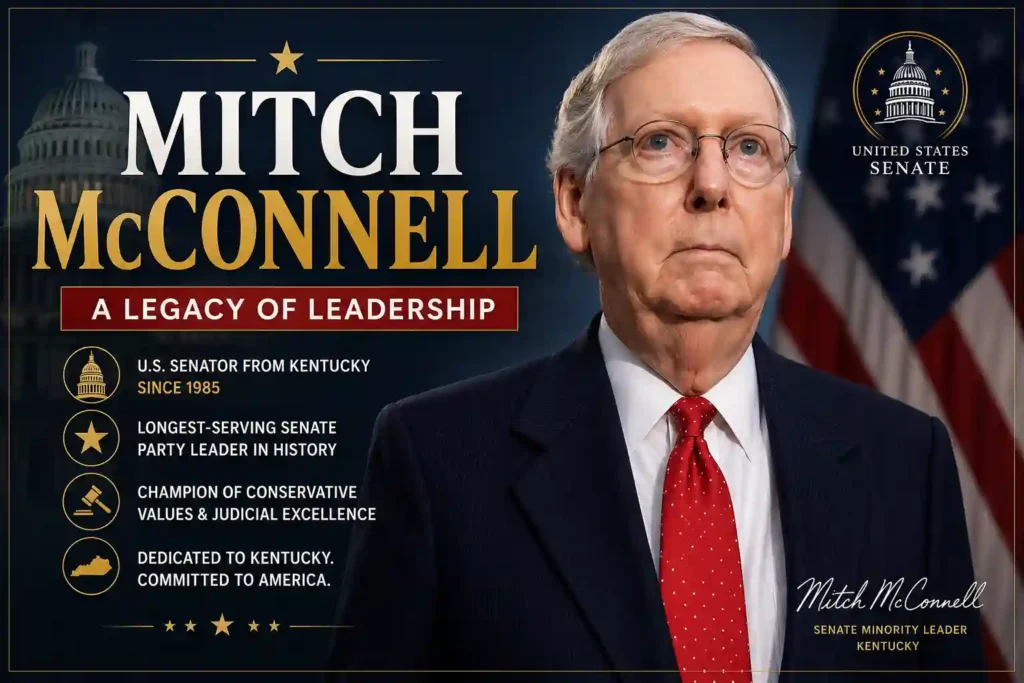
Mitch McConnell is one of the most influential and longest-serving politicians in modern American history. Known for his strategic leadership, disciplined political approach, and significant impact on the U.S. Senate, McConnell has played a central role in shaping the Republican Party for decades. Serving as the senior United States Senator from Kentucky since 1985, he became the longest-serving Senate party leader in American history.
Throughout his career, McConnell has been praised by supporters for his ability to advance conservative policies and criticized by opponents for his uncompromising political tactics. Regardless of political opinion, his influence on American government and the federal judiciary has been undeniable.
This detailed biography explores Mitch McConnell’s early life, education, political journey, major achievements, leadership style, personal life, and lasting legacy.
Early Life and Family Background
Addison Mitchell McConnell III was born on February 20, 1942, in Sheffield, Alabama, United States. He was born into a middle-class family and spent his early childhood in Alabama before moving to Kentucky, the state he would later represent in the United States Senate for decades.
One of the defining moments of McConnell’s childhood came when he was diagnosed with polio at the age of two. During the 1940s, polio was a serious and often disabling disease that affected thousands of children across the United States.
Doctors initially feared that the disease might permanently affect his ability to walk. However, his mother, Julia McConnell, remained determined to help her son recover. She regularly drove him to physical therapy sessions and ensured he completed his exercises. Through years of rehabilitation and determination, McConnell recovered successfully, although he has often credited this experience with teaching him resilience and perseverance.
His childhood battle with polio became an important part of his personal story and shaped his outlook on overcoming challenges.
Education
After completing high school in Kentucky, McConnell attended the University of Louisville, where he earned a Bachelor of Arts degree in Political Science.
While in college, he developed a strong interest in public service and government. He later attended the University of Kentucky College of Law, earning his law degree in 1967.
Following graduation, McConnell began working in legal and political positions that provided valuable experience in public administration and government affairs.
Beginning of His Political Career
McConnell’s political career began in Washington, D.C., where he worked as an intern and congressional aide. These early experiences introduced him to federal politics and the legislative process.
In 1977, he was elected Jefferson County Judge/Executive, the chief executive position for Kentucky’s largest county. During his time in local government, he gained a reputation as an efficient administrator focused on improving county services and managing public resources responsibly.
His success at the local level helped establish his political reputation and prepared him for statewide office.
Election to the United States Senate
In 1984, Mitch McConnell challenged incumbent Democratic Senator Walter “Dee” Huddleston in one of the closest Senate races of the decade.
McConnell narrowly won the election, becoming the first Republican to win a Senate seat in Kentucky in many years.
He officially took office in January 1985 and would go on to win reelection multiple times, making him one of Kentucky’s longest-serving senators.
Throughout his Senate career, McConnell consistently emphasized fiscal responsibility, national defense, judicial appointments, and conservative constitutional principles.
Rise Within Republican Leadership
Over the years, McConnell steadily rose through Republican leadership positions.
His deep understanding of Senate rules, negotiation skills, and disciplined political strategy earned the respect of many within his party.
Major leadership positions included:
- Senate Republican Whip
- Senate Minority Leader
- Senate Majority Leader
- Senate Minority Leader again after Republicans lost control of the Senate
His leadership style focused heavily on long-term planning rather than short-term political victories.
Many political observers consider him one of the most effective legislative strategists in recent American history.
Senate Majority Leader
In 2015, Republicans gained control of the Senate, and McConnell became Senate Majority Leader.
As Majority Leader, he controlled the Senate’s legislative agenda and played a major role in determining which bills and judicial nominations would receive votes.
During this period, he prioritized:
- Confirming conservative federal judges
- Passing tax reform legislation
- Strengthening national defense
- Reducing government regulations
- Supporting constitutional originalism in the judiciary
His leadership significantly influenced the direction of American federal courts.
Impact on the Federal Judiciary
One of McConnell’s most significant achievements was reshaping the federal judiciary.
Working closely with Republican administrations, he helped confirm hundreds of federal judges.
Perhaps his greatest influence came through Supreme Court confirmations.
During Donald Trump’s presidency, the Senate confirmed:
- Neil Gorsuch
- Brett Kavanaugh
- Amy Coney Barrett
These appointments shifted the ideological balance of the Supreme Court toward a more conservative direction.
Political analysts widely agree that McConnell’s judicial strategy will influence American law for decades.
Relationship with Presidents
Throughout his long career, McConnell worked with several U.S. presidents from both political parties.
His relationship with Republican President Donald Trump was particularly notable.
Although the two occasionally disagreed publicly, they collaborated on major legislative priorities, including tax reform and judicial appointments.
After the January 6, 2021 Capitol attack, McConnell strongly criticized Trump’s actions while maintaining his constitutional approach during impeachment proceedings.
His willingness to separate political disagreements from institutional responsibilities reflected his focus on Senate procedure.
Leadership Style
McConnell became famous for his disciplined, calculated leadership.
His approach emphasized:
- Strategic planning
- Patience
- Coalition building
- Strong party unity
- Detailed knowledge of Senate rules
- Long-term political goals
Supporters describe him as one of the most effective legislative leaders in American history.
Critics argue that his tactics increased political polarization and reduced opportunities for bipartisan cooperation.
Regardless of perspective, few dispute his effectiveness in advancing Republican priorities.
Personal Life
Mitch McConnell married Elaine Chao in 1993.
Elaine Chao served as U.S. Secretary of Labor under President George W. Bush and later as Secretary of Transportation under President Donald Trump.
The couple became one of the most recognizable political partnerships in Washington.
Despite his demanding political career, McConnell has generally kept his personal life private.
Health Challenges
McConnell has faced several health challenges throughout his life.
His childhood recovery from polio demonstrated remarkable determination.
In later years, he underwent heart bypass surgery and recovered successfully.
During recent years, several public incidents raised concerns about his health, leading to increased media attention.
Despite these challenges, he continued serving in the Senate while gradually reducing his leadership responsibilities.
Retirement Decision
After decades in public office, McConnell announced that he would not seek reelection when his current Senate term ends.
His announcement marked the conclusion of one of the longest political careers in the history of the United States Senate.
Many political commentators described his retirement as the end of an era for Republican leadership.
Major Achievements
Some of Mitch McConnell’s most notable accomplishments include:
- Serving as Kentucky’s U.S. Senator since 1985.
- Becoming the longest-serving Senate party leader in U.S. history.
- Leading the Senate Republican Conference for nearly two decades.
- Helping confirm hundreds of federal judges.
- Playing a central role in confirming three Supreme Court justices.
- Supporting major tax reform legislation.
- Influencing American judicial and legislative policy for generations.
Legacy
Mitch McConnell’s legacy remains one of the most debated in modern American politics.
Supporters view him as a brilliant strategist who strengthened conservative principles, defended constitutional government, and reshaped the federal judiciary.
Critics argue that his political methods contributed to increasing partisan divisions and made bipartisan cooperation more difficult.
Nevertheless, historians widely recognize that his influence extended far beyond Kentucky. His leadership transformed the Republican Party, changed the composition of the federal courts, and permanently affected the operation of the United States Senate.
Whether admired or criticized, McConnell’s role in American political history is secure.
Interesting Facts
- His full name is Addison Mitchell McConnell III.
- He survived polio as a child after years of physical therapy.
- He graduated from the University of Louisville and the University of Kentucky College of Law.
- He entered the U.S. Senate in 1985.
- He became the longest-serving Senate party leader in American history.
- He is married to former Cabinet Secretary Elaine Chao.
- He is widely recognized as one of the most influential Republican politicians of the 21st century.
Conclusion
Mitch McConnell’s journey from a young boy overcoming polio in Alabama to one of the most powerful figures in the United States Senate is a story of resilience, ambition, and political skill. His leadership shaped American politics through judicial appointments, legislative strategy, and decades of service to Kentucky.
Although opinions about his policies differ sharply, there is broad agreement that his influence on the Senate and the Republican Party will continue to be studied for generations. As one of the defining political figures of modern America, Mitch McConnell leaves behind a legacy that has permanently shaped the nation’s political landscape.